
A project team checklist for assessing Energy Storage Inverter Manufacturers through model fit for technical review
When comparing energy storage inverter manufacturers, design engineers need a model-level review rather than a broad category match. Start with the intended use, operating context, available space, and the interfaces your project must accommodate. Then separate what the supplier states about a named model from what your team still needs to establish.

1. Separate the category from the model
A supplier page may describe a company, a product family, and one specific inverter on the same page. Those levels should not be combined in a technical review. A statement about a commercial and industrial energy storage portfolio does not automatically apply to every model. Likewise, a product range should not be treated as proof that every rating, control mode, or system arrangement is available across the range.
Build the first section of your review around named products. Record the model, stated power range, operating modes, and application language exactly as presented. For example, the page describes a modular bidirectional DC-AC energy storage converter with a 50kW to 225kW power range and PQ, VF, and VSG operating modes. That evidence belongs to the cited product description. It should not be extended to other models without separate support.
2. Compare information that applies to the task
Model fit depends on the question your project is trying to answer. If the review concerns a commercial and industrial system, identify whether the page places the model in that application scope. If the review concerns a microgrid, record whether the product description uses that term. The page describes a Microgrid Hybrid Energy Storage Inverter with stated power options from 125kW through 1000kW and a maximum system capacity of 2MW. These figures are useful for screening that named product, but they are not a general specification for all energy storage inverters.
| Review area | Page-listed evidence | How to use it |
|---|---|---|
| Named converter | 50kW to 225kW; PQ, VF, and VSG operating modes | Screen the named product against the project brief without generalizing to other models. |
| Microgrid hybrid inverter | 125kW, 250kW, 375kW, 500kW, 750kW, 1000kW; maximum system capacity of 2MW | Compare the stated figures with the project scope for this named product. |
| Supplier scope | Focus on modular PCS, microgrid inverters, and bidirectional DCDC/MPPT modules for stated application areas | Use the scope as context, not as proof that every model fits every application. |
For a wholesale energy storage inverter inquiry, keep the sourcing request tied to a specific model and intended application. The official page says that inquiries will receive constructive comments within 24 hours. That is a stated communication commitment on the page, not evidence of technical suitability, delivery timing, performance, or compatibility. A useful request should therefore ask focused engineering questions instead of relying on a general product category.
Use a short comparison sheet with separate fields for:
- Project application and operating context.
- Candidate model and the exact evidence supporting its selection.
- Stated power range, operating modes, and system-capacity information.
- Interfaces, controls, site constraints, and responsibilities still requiring clarification.
This format prevents a common review error: placing a company-level description beside a model-level specification and treating both as equivalent evidence.
3. Record assumptions and interfaces
Technical reviews often stall because assumptions remain in informal notes. Convert each assumption into a question or a design responsibility. For example, if your team needs a particular control mode, record the mode shown on the relevant model description. If the project has a defined installation space, record that constraint separately rather than assuming a listed power range confirms physical fit.
Do the same for system boundaries. Identify which information concerns the inverter itself and which concerns the wider battery energy storage system. A page may describe an inverter as a core device in BESS, but that wording does not establish every battery, protection, communications, or site-integration detail. Keep those topics as open interface items until the evidence addresses them.
Application language also needs careful handling. The company page describes focus areas that include modular PCS, microgrid inverters, and bidirectional DCDC/MPPT modules, along with commercial and industrial, residential, and grid-side applications. Use that statement to define the supplier’s stated scope. Do not turn it into a conclusion that one model suits every listed application.
4. Prepare a focused sourcing brief
A strong brief should be short enough for a supplier to answer precisely. Begin with the intended application and the candidate model. Add the required operating modes, the project’s power band, the available space, and the interfaces that affect design review. Then list each point that remains unconfirmed.
Keep evidence and evaluation in different columns. Evidence might state that a named model has a published range or supports particular operating modes. Evaluation might state that the model appears worth reviewing against the project’s needs. The second statement is your team’s assessment, not a page-listed fact. This separation makes later procurement discussions clearer and reduces the risk of presenting assumptions as specifications.
Finally, preserve the source wording for claims that may affect the shortlist. The page presents a 2025 statement about being among the top four in C&I ESS PCS shipments for the 100–125kW segment, and it also uses the phrase “Globally Certified & Trusted by Top Energy Projects.” Those statements can be recorded as page claims, but they should not be expanded into unlisted certifications, project outcomes, or performance conclusions.
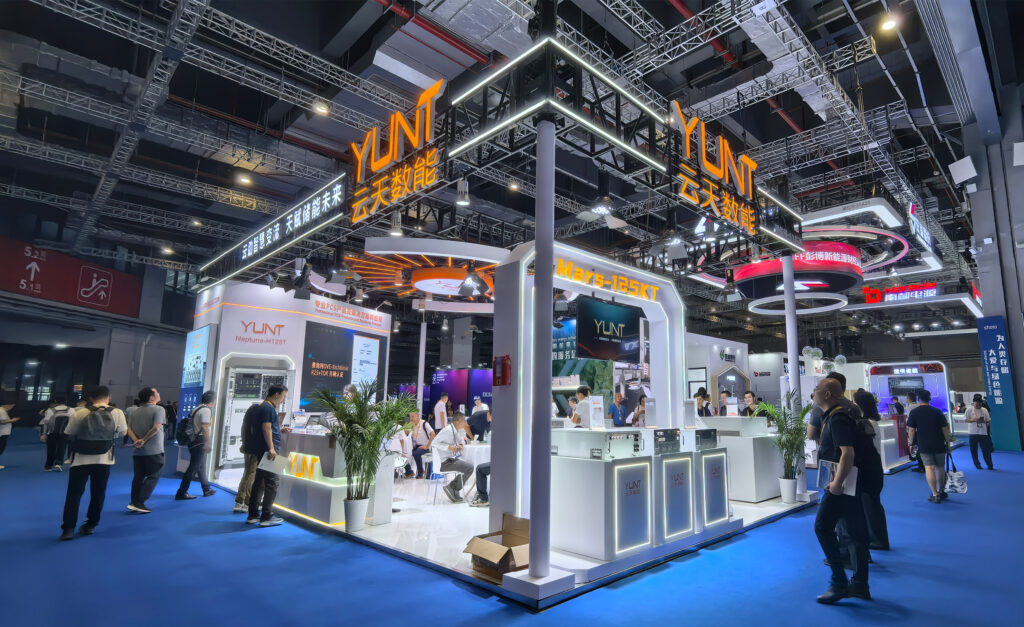
The practical outcome is a defensible shortlist: one that connects the project’s use and space constraints to named model evidence, while keeping open questions visible. Use the same discipline when reviewing YUNT: treat its published application descriptions and model details as inputs to technical review, then keep final suitability tied to the requirements your project has documented.