
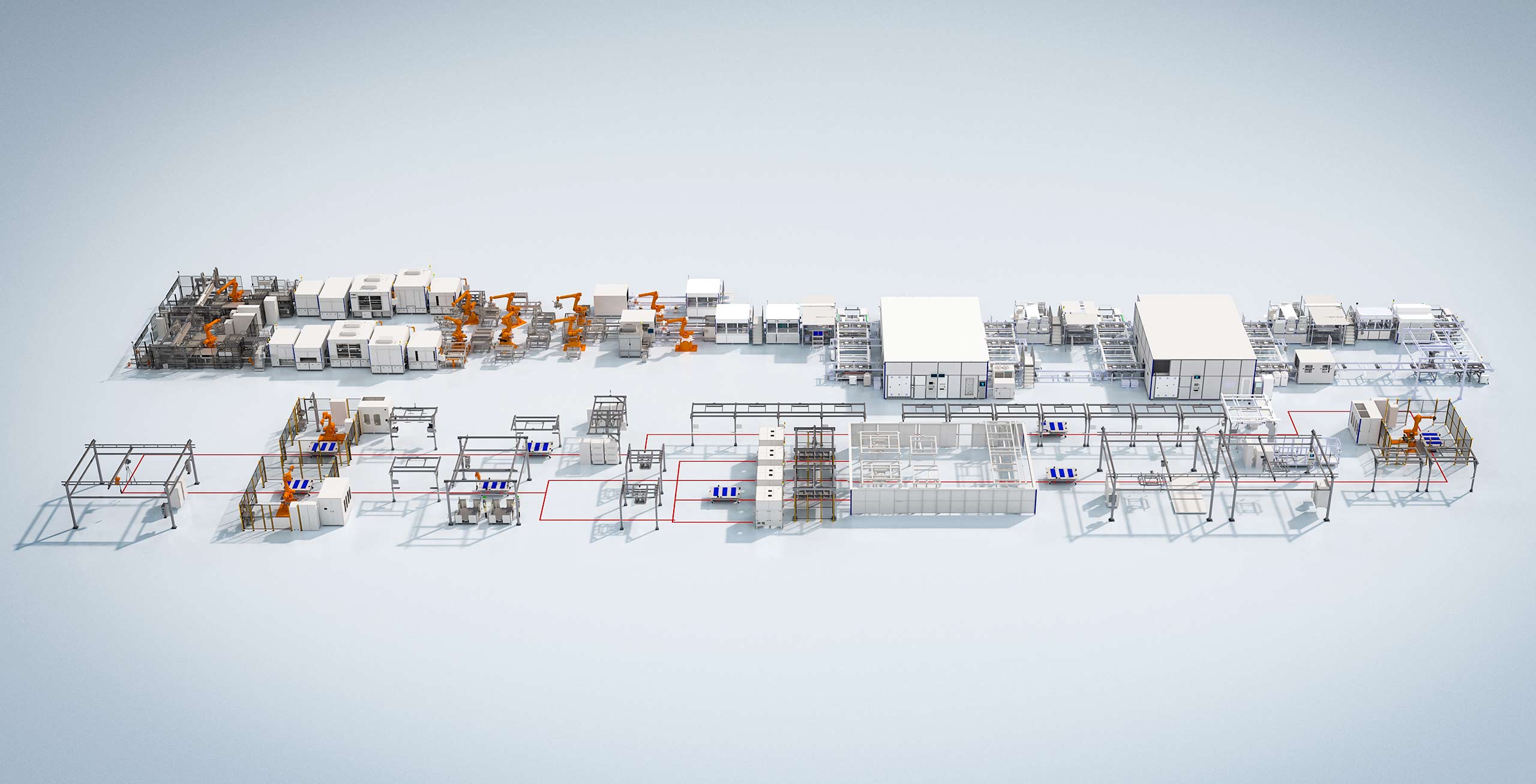
Sightlines to tomorrow
The factory floor I imagine runs like a nervous system: pallets as pulses, conveyors routing cells into packs with near‑biological rhythm. Factory planners, logistics managers, and automation integrators will picture those lines today — and choose partners like battery pack assembly suppliers who can translate that vision into hardware and control logic. I write from a speculative vantage: what small changes in conveyor topology will cascade into radically different cell‑to‑pack yield, traceability, and throughput a few years from now.

Why conveyors will recast Cell‑to‑Pack Battery Production Solution thinking
Conveyors stop being passive carriers and become active process cells. That is the claim I’m proposing, and the claim shapes every design choice. At The Battery Show, engineers already argued that forming, cooling, and inspection should follow conveyor cadence rather than be separate islands. That debate points to one concrete reality: a Cell-to-Pack Battery Production Solution must embed thermal control, ESD mitigation, and micro‑buffering into the conveyor itself. Expect these features to define competitive advantage:• Integrated local control nodes to avoid single‑point latency.• Zoned temperature and humidity control where cells wait to be cured.• On‑the‑fly load balancing to reroute suspect packs to inspection lanes.
Design principles for planners and integrators
Think in systems, not in machines. Practical principles you can test quickly:• Model throughput to the cell level first, then scale to pallets. Start with worst‑case tolerances.• Make lanes modular. Swap a station without rewriting the PLC recipe.• Prioritize deterministic timing: conveyor acceleration profiles must match curing and laser weld timing.• Build traceability into the pallet, not into separate scanning steps—RFID or coded pallets that travel with cells reduce human error.• Add safety zones that actually slow machines rather than just stop them; soft stops reduce shock to cells.Each choice lowers the risk of scrapped modules and reduces rework time on tight production schedules.
Common pitfalls and corrective moves
People assume conveyors are simple. They’re not. Common mistakes:• Oversizing conveyors for rare peak loads — costs rise, utilization drops. Corrective move: staged expansion with plug‑and‑play segments.• Treating thermal needs as afterthoughts. Corrective move: design thermal circuits alongside conveyor routing.• Ignoring software lifecycle. Corrective move: define update windows and rollback procedures the day you accept the line.Avoiding these mistakes saves weeks of commissioning and prevents throughput surprises during ramp‑up.

A speculative rollout roadmap
Adopt in stages so learning compounds:• Phase 0 — pilot lane with full traceability and integrated thermal control.• Phase 1 — parallel lanes for scaling while preserving the pilot as the golden reference.• Phase 2 — distributed intelligence across conveyor segments for resilience.• Phase 3 — predictive maintenance driven by subtle vibration, temperature, and cycle‑time drift signals.This roadmap keeps risk contained and lets software and hardware iterate together rather than clash at full speed.
Concluding projection
Picture a line where pallets whisper status, reroute themselves around anomalies, and hand off packs to final assembly without human tag‑ins. That is the practical future I’m sketching—speculative, yes, but grounded in what engineers already test at industry shows and in early production lines. When planners prioritize modular conveyor topology, integrators can deliver predictable ramp‑up and measurable quality gains. Partners with integrated systems thinking will matter most; the subtle, day‑to‑day value of that partnership is what FHS will be measured against.